
J’Accuse!

Could Jews This Year Be Chayav Kares for Looking Away From Har HaBayis?
By Rabbi Josh Wander
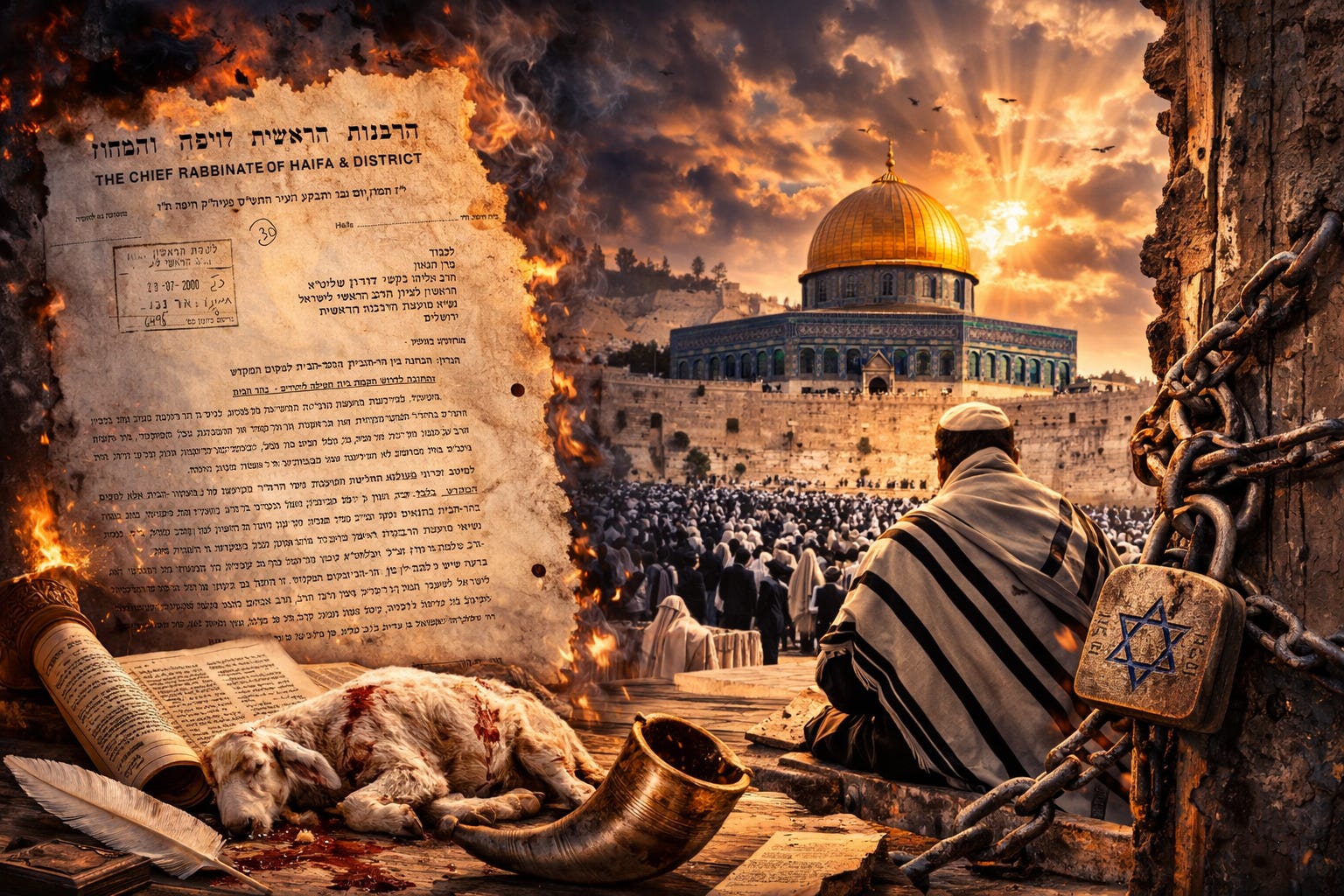
For decades, the conversation about Har HaBayis has been governed by fear. Jews are repeatedly warned about the grave prohibition of entering forbidden areas of the Mikdash in a state of impurity, and the word kares is invoked with trembling. That concern is real and rooted in Halacha. The sanctity of the Makom HaMikdash is among the most serious categories in Torah law. Yet something deeply strange has developed in the religious discourse surrounding the Temple Mount. While enormous energy is devoted to warning Jews about the possibility of kares for approaching the sacred improperly, almost no attention is given to another kares described explicitly in the Torah—the punishment for failing to bring the Korban Pesach when one is obligated and able to do so.
That verse is not obscure or mystical. It appears plainly in the Torah itself. And yet an entire religious culture has developed that is extremely sensitive to the danger of coming too close to holiness, while almost entirely silent about the possibility of rejecting a mitzvah tied to that same holiness. This imbalance raises a profoundly uncomfortable question: how did we become so vigilant about one form of kares while barely acknowledging the other?
The question becomes even more difficult when one considers the historical reality of the past six decades. For nearly sixty years the Jewish people have stood once again in control of Har HaBayis. For the first time in two thousand years the place toward which we pray three times every day is no longer an inaccessible site under foreign rule. Jewish sovereignty returned to Jerusalem, and access to the Temple Mount returned to Jewish hands. Yet despite this extraordinary change in reality, the mitzvos associated with that place have remained largely absent from serious public discussion. The Mikdash lives powerfully in Jewish liturgy and imagination. We mourn its destruction, sing about its rebuilding, and teach children to envision it. But we rarely speak about it as a living halachic reality that may carry practical obligations.
This silence becomes even more striking when one examines how major Torah authorities approached the issue. The Chasam Sofer did not dismiss the possibility of bringing the Korban Pesach in modern times as a messianic fantasy. He treated the subject as a genuine halachic question and addressed its complexities seriously. Contemporary gedolim also recognized that the matter could not simply be ignored. After the Six Day War, the Lubavitcher Rebbe reportedly instructed people to avoid being in Jerusalem on Erev Pesach and Pesach Sheni because of the potential obligation associated with Korban Pesach. Reports also exist that Rav Chaim Kanievsky, along with other leading rabbinic figures from different communities, purchased a share in a sheep before Pesach in case circumstances changed and the mitzvah suddenly became actionable. Whether or not one believes the practical conditions exist today, these actions demonstrate that the question itself was taken seriously by some of the greatest Torah minds of our generation.
This makes the broader silence of the Torah world difficult to understand. If the Torah is real and its mitzvos are binding, how can such a question simply disappear from the national conversation? A community that trembles at the thought of violating halacha should at least be equally troubled by the possibility of neglecting a mitzvah carrying the same level of severity.
The issue becomes even more troubling when we ask where rabbinic leadership has been in addressing this transformation in Jewish history. Where are the Chief Rabbis? Where is the national halachic guidance that should accompany the return of Jewish sovereignty to the holiest site in Judaism? On smaller and less consequential matters, rabbinic rulings are issued quickly and confidently. Public campaigns are organized and statements released. Yet on the great national questions of our generation—Har HaBayis, Korban Pesach, and the practical implications of redemption—the response has too often been silence or deflection.
The most common answer offered is that these matters are “not for now.” But after sixty years, such a response becomes increasingly difficult to defend. The reality on the ground has changed dramatically, yet the halachic conversation appears frozen in an earlier era.
Evidence suggests that even within the rabbinic establishment itself there has been awareness of this failure. In a sharply worded letter written in 2000, Rav She’ar Yashuv Cohen, a member of the Chief Rabbinate Council and former Chief Rabbi of Haifa, called for the Rabbinate to distinguish clearly between Har HaBayis and Makom HaMikdash and argued for the establishment of a Jewish place of prayer on the Mount. In that letter he wrote that, to the best of his memory, the Rabbanut had never actually prohibited entry to the entire Temple Mount, but only to the specific area identified as Makom HaMikdash itself. He also noted that several prominent rabbinic figures were aware of this distinction and had encouraged him to reopen the matter before the Rabbinical Council. Such testimony from within the Rabbinate itself suggests that the issue was never fully or adequately resolved.
Research conducted by David Rapport, who reviewed Rabbanut material from the years following 1967, points to a similar conclusion. According to his findings, the Chief Rabbinate failed to fulfill what might reasonably be considered its institutional responsibility: to establish the precise halachic boundaries of the site and provide a clear national standard for the Jewish public. Rapport describes a pattern of committees that were formed but never met, discussions that were scheduled and later canceled, and an absence of a comprehensive psak explaining the reasoning behind existing policies. In his formulation, it would be more accurate to say not that the Chief Rabbinate categorically prohibited ascent to Har HaBayis, but rather that it failed to clarify the halachic boundaries that would allow the issue to be addressed responsibly.
None of this implies that the questions involved are simple or easily resolved. The halachic complexities surrounding Har HaBayis are immense, and the political and security implications are no less serious. Precisely because of that, however, the subject demands careful and courageous leadership. If the correct halachic conclusion is caution, then that caution should be explained and articulated clearly. If the correct conclusion is prohibition, then that prohibition should be grounded in transparent reasoning. And if the correct conclusion is that action must wait for further developments, that delay should still be accompanied by serious preparation and honest national discussion.
What cannot continue indefinitely is a pattern of avoidance in which the return of Har HaBayis to Jewish hands is treated as though it has no halachic implications at all. Such an approach risks turning one of the most central places in Jewish theology into little more than a symbol—something we mourn and sing about but never engage with as a living reality.
For a Jew who believes that the Torah is eternal, that the sanctity of the Makom HaMikdash remains, and that Jewish sovereignty in Jerusalem carries real meaning, the subject should not sit quietly at the margins of discussion. It should provoke serious reflection and even a measure of trembling. The real question facing the Jewish world today is not whether we understand the gravity of approaching holiness improperly. We clearly do. The deeper question is whether we are equally sensitive to the possibility of turning away from holiness when history itself places it once again within reach.
This leads us back to the uncomfortable question with which we began: Could Jews this year be chayav kares for looking away from Har HaBayis? Perhaps the answer is no. But if the Torah truly governs Jewish life, then the fact that the question is rarely even asked should itself give us pause.
Bring on the rabbinic rulings for 3rd Temple! Bring on the instructions! Can’t wait! American Jews who don’t come here are out to lunch. Some light has turned off inside them unfortunately. Once lunch is served at the 3rd Beis Hamikdash, suddenly they will want reservations.
I have wondered about these same things over the years, and am glad this is being discussed and being written about. Now that more Jewish people are ascending to the mount in a specific pathway to address some of the concerns, and that we are praying openly there without fear of restraint, perhaps this will change as well. Soon may the Beit HaMikdash be rebuilt, speedily and in our days. Bz"H